Showing posts with label organization. Show all posts

Saturday, September 6, 2014

Tips and Tricks for Itinerant SLPS

I have several SLP friends who have shared their classroom decor with me as the beginning of the school year is approaching us.  The rooms are always colorful and inviting.  Therapy materials are all organized neatly in cabinets with children's book lined up according to author on bookshelves.  Jerks.  Just kidding, but in all seriousness, I can't help by feel a little envious. 

For those who are more like me, who has traveled between two to five buildings over the course of my three year career, you quickly learn how to make a traveling position work for you.  This, of course, was done through trial and error and what I have found to work for me.  Without further explanation, here is how I survive being between multiple buildings while not necessarily having my own space.

Mock schedule on google calendar

Mock print out of schedule using google calendar
 1.  Plan ahead.  In my first year, I literally would plan therapy sessions minutes before grabbing the kids from class.  I now plan therapy sessions ahead of time.  What I found worked for me is scheduling my kids using Google calendar.  I printed out my calendar by day (Monday had it's own page, Tuesday had it's own page, etc) and would write the child's next target goal (ex: /g-/ unmodeled words, stage 3 mindwing program, etc) next to their name on the schedule immediately following their current session.  This was a great easy way to plan therapy, took less than a minute, and I was able to make sure we were progressing in therapy as usual.  Although I progress monitor in one form or another during each session to help guide my therapy, my agency also requires that we formally plug in progress monitoring data points once a month, so I always felt that sessions were planned according to the child's progress and needs.  I also liked using Google calendars because I could easily change the schedule if students were dropped or added and I only printed out the calendar weekly, so it was always up to date.  One more quick bonus for using Google calendars is you can color code your schedule, so for each school I was serving, I color coded students to help keep myself organized.


2.  Organize your materials in a way that works for you.  This will be different for everyone.  Ideally, I would love to have one school and one classroom and have all my materials in one convenient spot.  However, this is not the case.  I am between multiple buildings and I have personally found that keeping most of my therapy materials at home is what works best for me in this scenario.  We have a home office in my house and I keep my materials in a bookcase and organized in the closet.  I keep binders/workbooks at the school I am at the most since when I use them, I usually photocopy pages and I don't have a photocopier at home.  I rarely use workbook activities, so this ends up working well and I will photocopy homework sheets in bulk as I need them.  I also keep general office supplies at each of my schools (staplers, paperclips, tongue depressors, etc), as well as students files.  The main reason I keep my therapy materials at home is to avoid making extra trips to my schools if I forget materials.  I also got approved to home office this year, which has made life easier since I can go home and scope out my materials while planning therapy sessions between multiple buildings.

3.  Go as digital as possible.  When I started working between four different schools, Google became my best friend.  I kept my calendar and email on Google, as well as utilized Google docs.  Google docs prevented me from having to use a flash drive and also allowed me to work on documents between buildings (as well as share documents with school teams/parents).  I kept all student session notes on Google forms, which was wonderful.  I could open up a students' session notes without carrying files between buildings, which was great.  The one downside is you need consistent internet access for this system to work.  However, if you do have consistent internet connection, I highly recommend Google forms for session logs.  If you are interested in the google form I use for data collection and logs, let me know and I can do a separate post to share my system or do a tutorial on how you can make your own google form.

4.  Reach out to faculty and staff at each school.  This has been the most challenging for me, personally.  I'm not naturally outgoing and despite what I may advise, I always eat lunch in my office so I can keep up on my paperwork (although I'd advise trying to connect with teachers by eating lunch in the lounge).  Not being present in the same building everyday can definitely make one feel less a part of the school community, but sometimes you need to be the one to extend the olive branch.  Ask the special education teachers out to lunch.  Give the faculty an in-service about the SLP role in the school (I have many teacher friends from college that consistently tell me they have no idea what the SLP does in their school), bring homemade goodies during the holidays, sign up to be part of the social committee, and be present at the student support meetings just to name a few ways to stay connected..  You can even email monthly newsletters about the exciting world of speech-language pathology to promote your services and to have a presence in the building when you can't physically be there.

5.  Group students for therapy when appropriate and adapt 5 minute kids for those who are appropriate.  Even with a small caseload (which I don't have), scheduling students between multiple buildings can be extremely stressful.  When I first started, I saw all students individually (I also had 45 kids).  Although seeing students individually does have it's benefits, I found that my students made the same type of progress in language groups and during 5 minute kids (actually, my students made faster progress with 5 minute kids!).  Seeing students individually left very little gaps in my day for paperwork, observations, and referrals.  It was also difficult to fit the new kids who qualified for services during the school year.  Remember, it is completely okay to have time during the school day that is not occupied by therapy.  In fact, if you look at the workload activity cluster on the ASHA website, direct service occupies the smallest cluster.  We have a lot of responsibilities outside of direct contact with students and we shouldn't be expected to complete that in the one hour we have before and after school.  Some days I don't have those hours before and after due to student support meetings and IEP meetings, so it's almost necessary that I do create space in my day for indirect services.  Grouping students together and adapting five minute kids, at least for me, has freed up time I can be spending on my other responsibilities and ways to indirectly serve students  

6.  If you have the opportunity to utilize a speech language therapy assistant, do so!  My caseload is hovering around the 60 mark, which between multiple buildings, can be challenging.  Luckily, our agency does give us the opportunity to apply for assistance from a para.  It has been extremely helpful to have someone to take groups for therapy since I have had to double book some of my kids this year due to scheduling issues (we can't pull out of specials, math, reading, and not to mention when they go down for academic support).  Last year was my first year with a SLPA and I was a bit nervous having someone else work with my students, but as long as you offer ongoing trainings and students are making progress, SLPAs can be life savers! 

7.  Last, but not least, invest in some good luggage! I use a very sturdy Vera Bradley bag for my laptop, traveling binder, and student files as needed.  I then use my free SuperDuper bag to carry the day's therapy materials (although I heard ThirtyOne sells this bag that is wonderful for carrying therapy materials).  If you live in an area where it does not snow and your schools have access to ramps and elevators, rolling luggage is wonderful.  I had one last fall, but unfortunately it was more cumbersome for me since it was impossible to drag through the snow and I ended up having to carry it up and down stairs at school.

How do you keep sane and organized if you are at multiple schools?

Happy Speeching!

-Courtney


Saturday, February 8, 2014

What's in my Speech Bin: February 2014


1.  The Day it Rained Hearts:  This book is my favorite book to read around Valentine's day.  It is great for sequencing and inferencing.  I have my students guess who she is making the valentine's for while we read and then we discuss how we know it is meant for that character.  I also have a board maker activity that I use for categorizing and descriptive words where there are descriptions for each character and the students have to decide what characters the descriptions go to (long ears for rabbit, green for turtle, etc).  Find this book here.

2.  Foam Hearts:  I could not find the actual foam hearts I got online, but I found mine at Target (I'm sure Walmart, Michael's, Hobby Lobby will have them!).  The bag I got had a variety of colors, textures, and sizes.  I use these for many goals, such as categorizing (by color, texture, size), prepositions (put the little heart in the middle, between the big hearts, etc), concepts (pick a hear from the pair/several/many pile), and descriptions/directions (give me the glitterly medium purple heart).  It is also great for a reinforcer for articulation activities.  The kind I got had sticker backing, so after they said the designated number of target words/sentences, they would get a heart to put on their sheet.  We also make homework sheets by writing target words on several hearts that I put in a baggie to send home and they can stick them on a sheet of paper once they practice the words at home.

3.  Arthur's Valentine:  Most of my younger kiddos love Arthur books.  It's also a great book to discuss teasing/social issues since Arthur gets teased in the story by his friends for getting Valentine's cards.  We put "thought bubbles" above the character's head to guess what they are thinking in this story by using post-it notes.  Find this book here.

4.  Mail Boxes:  I don't know where to find these online, but I found mine in the dollar bin at Target.  I use these a lot to make categorizing and sorting activities more motivating.  For my "speedy speech" or 5-Minute Kids, I make drill more interesting by having them place artic cards in the mailbox after they practice the target word.  I have also used them with my Secret Articulation Sort, which you can learn more about here.

5.  Froggy's First Kiss:  What kid doesn't like a Froggy book!?  Seriously, name one, I dare you.  I use this as a general retell book, inferencing (who is Froggy making the Valentine for!), and emotional vocabulary (love, embarassed, etc).

What kinds of materials are you using in Frebruary?

Happy Speeching!

-Courtney

Sunday, February 2, 2014

123TokenMe App for Speech Therapy

I am a speech-language pathologist who does use behavior systems and stickers charts with most of my kiddos.  I tailor each system to the child's specific need.  If a child has trouble remembering their speech folder, I reward them for remembering.   If I have a "runner" I reward them for participating in speech.  If I have a kiddo who does not like doing speech homework, I reward them when they do complete homework tasks.  Given, some of my kids are self motivated and the idea of "graduating" from speech is enough for them, so there is no need for a system to be put into place.  I am by no means a behavior expert, but I do believe in the power of positive reinforcement.

In the past, I have done positive reinforcement with penny boards for more of an immediate reward, as well as sticker charts for more long term goals.  Now that I am between four buildings, I am really trying to simplify as much as a can, which I am finding involves going as "paperless" as possible.

I had been searching and searching for an "sticker chart" app, but most the ones I had found can only manage four or less sticker charts at a time.  With a rather large caseload, this was not an option.  I finally bit the bullet and paid the $9.99 for the 123TokenMe because it was the only one I could find that could hold a whole caseload's worth of charts.  The good reviews also sold me on it.

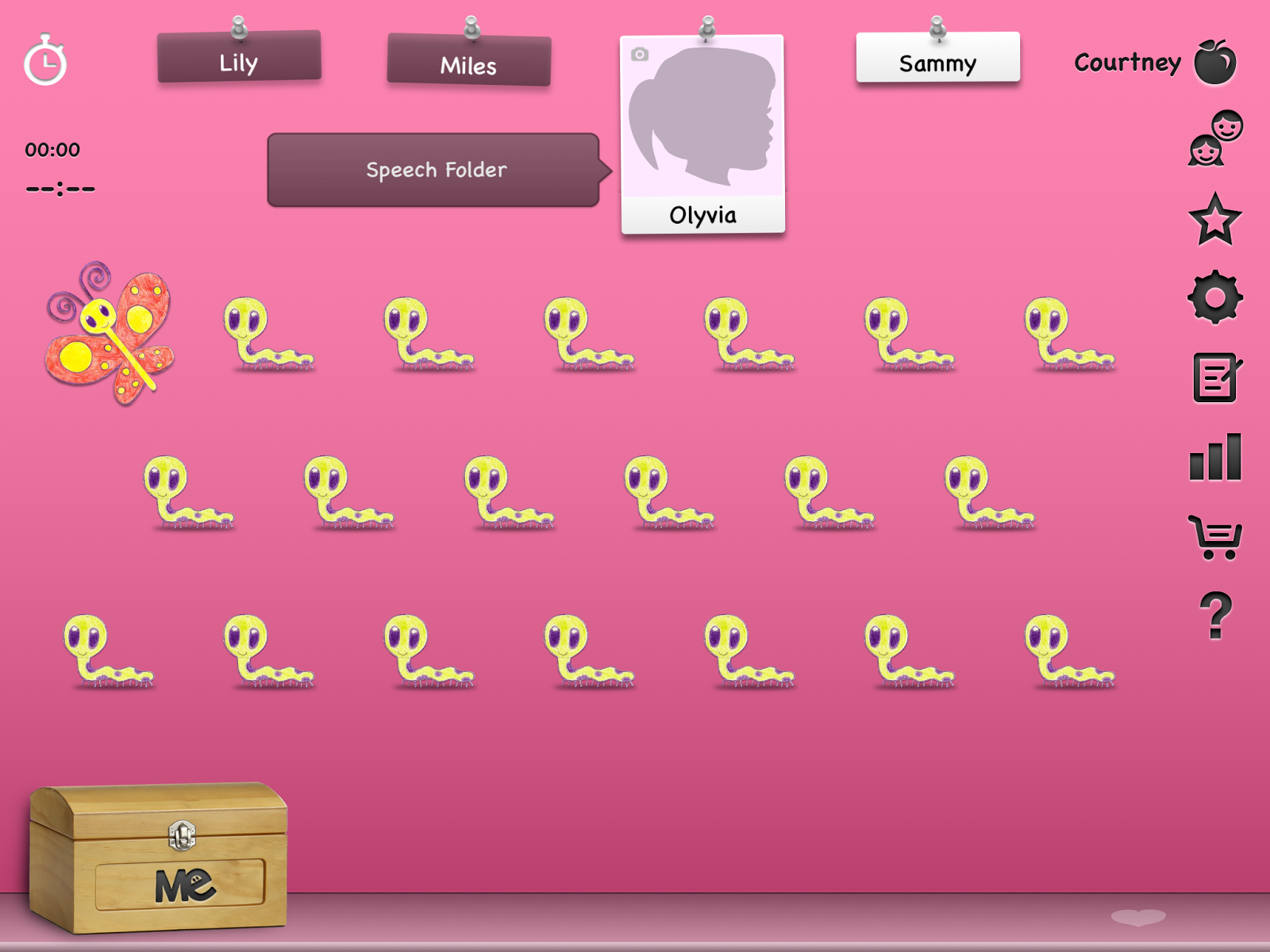
I am SO happy I spent the money on this app.  I will never go back to paper sticker charts!  Basically, this app allows me to create an individual chart for each student on my caseload (at least the ones that need it).  You can pick from a variety of backgrounds and "tokens" to reward the behaviors.  If you are reinforcing a behavior in intervals (such as rewarding if they are in their seat or paying attention every 3 minutes), the app comes with a timer that will remind you to reward.  Since every student is different, you can control the number of token the student receives to get their reward.  There is also a place to document the behavior you are reinforcing, as well as a place for a visual for what they are working for.

Here are just a couple screen shots for some mock students:


I am loving this tool so far! I have used it for rewarding behaviors such as remembering their speech folder, completing homework, and being an active participant in speech.  I have also used it for speech production practice (for each correct production, the get a token and once all token are full they get a turn in a game).  I have also used for carryover for articualtion.  For example, while taking a conversational sample I have my timer set for every 2-3 minutes and if they are using their target sound correctly when the timer reminds me, they will get a token.

Check out more details about this app here!

Happy Speeching!

-Courtney


Monday, January 20, 2014

Symbaloo: Organize your Online Resources

Today, while meeting up with a couple veteran SLPs at my agency to discuss some complex language kiddos, I glanced over at my coworker's computer and saw something that made my heart skip a beat: Symbaloo.  Up until today, I had not heard of Symbaloo and the minute I had some free time I signed up and set up my homepage.

What is Symbaloo?  Well, I am no expert, given that I've only used it today, but I will say that it has already helped me become more organized and has given me a quicker way to access my online resources.  Using my own words to describe it, I would say it is a visual representation of websites you may "book mark" or "favorite," which you can set as your homepage to give easy and quick access to your frequently visited sites.  If you know me, I love to organize, so I immediately fell in love with this tool. 

Here is my Symbaloo "home page."


You can color code your sites.  I just started organizing my sites into four categories so far, including:

Green: Search Engines (yahoo, google, etc)
White: Work  Sites (email, google drive, IEP site, district site, etc)
Yellow: Products (LinguiSystem, TpT, SuperDuperInc)
Purple: Speech Sites (ASHA)

I plan on adding good speech blogs on there in a different category =)

I think this is such a great tool for SLPs, or really any profession, to help organize their resources.  I use the internet and webpages all the time for resources, so this just made my life a whole lot easier!  Not to mention the set up of Symbaloo reminds me a little of how an AAC device would be set up =)

Do you think you will use Symbaloo to help organize your online life?  Learn more about how to set up and use Symbaloo here.

Happy Speeching!

-Courtney

Tuesday, January 7, 2014

What's in My Speech BIn: January 2014

With the new year, I wanted to create a new series called What's in my Speech Bin.  I did a post awhile ago describing how I organize my seasonal/monthly materials here.  Each month I will post a little sneak peek of some of the materials I keep in my monthly bins.  I just put these bins together last spring, so I am anxious to add more materials as the time goes on!  So, let's start out with January!


I won't go into too much detail on how I use these in therapy, but here is a brief overview:

1.  Snowman Stacker:  I have used this to teach size concepts, as well as following directions.  It is also a great reinforcer for articulation (say ten words, stack one part of the snowman).

2.  The Snowy Day:  I cannot give enough praises to this book.  It is great and simple and classic.  It's great for introducing some winter vocabulary, cause and effect, and for beginning narratives.

3.  Penguin Popper:  This is such a motivating tool for articulation kids.  In the past, I have made a target on my whiteboard (each part of the target is assigned points) and the children try to aim for the center.  If the hit the center, they earn 10 points and have to say their target word ten times, if they hit the first ring they earn eight points and say the word eight times, etc.

4.  Snowmen at Night: Following reading this story, I have had kids work on describing by drawing their own snowman and coming up with adjectives to describe.  We have also worked on story telling and narratives by telling a story about what their snowman does at night when no one is watching!

5.  The Mitten:  Anyone who reads this book knows it is great for sequencing!

6.  Fake Snow:  The kind I bought was actually sold out, so I put a link to some more on amazon (or learn to make your own here).  I have made fake snow in a bucket and have hidden objects in there for describing or articulation.  I have also used fake snow while reading The Snowy Day and have the kids make different kinds of tracks in the snow to keep them engaged in the story, as well as learn winter vocabulary (make snowman out of the snow, snow angels, tracks, hills, etc).

What are some of  your favorite seasonal activities and materials for January?

Happy Speeching!

-Courtney


Wednesday, October 2, 2013

Why Washi Tape is a SLP's New Best Friend

I have been coveting washi tape for a while now.  I'm not sure what it is about it that makes me want it so bad.  It's cuteness?  It's colorfulness?  My need for everything organizational and office supplies related?
I have been having fun with my washi tape in speech the last couple of days.  Here is how I have been using it:
1.  As Place Holders

I have several kids who need to take breaks during sessions or sometimes will bring toys to sessions.  When break time is over, it helps to have a designated spot for their toy or break activities.  Hence, the "X."  For kids who have trouble keeping their hands off the game board when it is not their turn, making two x's with the tape gives them a clear spot on where their hands should be.

2.  For Directional and Spatial Tasks


I have some super fun road washi tape that my kids love creating little tracks or towns with.  In this case, we were working on spatial concepts above and below.  We had fun moving the dinosaur above the road, below the road, or on the road. 

3.  For Personal Space Boundaries 


I had a student last year who did not understand the concept of personal space and would be practically in my lap by the end of the session.  This is where that visual line of "your space" and "my space" comes in handy. 
4.  Group Data Collection


This saves me from flipping from folder to folder to take data.  I typically don't see my students in groups more than two, but in this case, I had some sessions to make up and did not have a choice.  This is so much easier and manageable than flipping between folders! 

5.  Taking Data in the Classroom


Need to get some data for generalization?  No problem!  Slap some washi tape on the pant leg and go at it!

6.  Organizing my Calendar


I am all about the planner.  I have been using my washi tape to block out certain weeks.  Not to mention there are about a billion patterns and colors to choose from, so color coding is super easy!

You can find washi tape for sale here!

Happy Speeching!

-Courtney


Sunday, September 8, 2013

The Age Old Question: What to do with Missed Sessions?

While spending my Sunday afternoon browsing Facebook, I saw a question on Jenna Rayburn's (from Speech Room News) status from a speech-language pathologist:  How do we deal with missed sessions?

This question was a bit of a hot-button issue my first two years of working in the schools.  In my first year, we were strongly encouraged to make up every session that was missed, whether it was student absence or the speech-language pathologist's.  With a caseload of fifty (which is far less than I've seen other speech-language pathologists have) and no option of substitutes, missing a day of work due to PD or illness was like a death sentence.  It even got to the point that we were expected to makeup minutes that the children would be missing over holiday breaks.  That did not last long, however, as it was soon realized that this goal was completely unrealistic.  To make up sessions, I would have to group more students together and sessions became more about the quantity and less about the quality.  I'm all about keeping compliance with the child's IEP, it's written and designed by the team for a good reason, but when you're seeing a group of five to six kids for the sake of meeting minutes and not much else, quite frankly, it's a waste of the student's instructional time and my own.

On Jenna's Facebook post, a speech-language pathologist recommended going to the ASHA website and searching "missed services," so I did just that.  This article/notification popped up.

In a nut shell, it explains that the state or districts should not be creating policies on how missed sessions should be made up.  Instead, the IEP team should be the decision makers on how great an impact missed sessions would have on the student's FAPE and determine what the outcomes should be to ensure FAPE.

I am curious to try the 3:1 model to help with making up missed sessions in a productive and efficient manner, but have not yet figured out to make this work in my district or agency, although I believe it is something they are looking into.  For now, I reserve Wednesday afternoons for meetings (my district has monthly meetings on  Wednesday afternoons), as well as IEP meetings, work time, and make-up sessions.  This has worked well for me in the past.  I also write a statement on my student's IEPs (individualized for specific students) that addresses the issue of missed sessions.  For example, while describing their services, I may write:

"Minutes per month may vary due to limited student absences, limited speech-language pathologist's absences, school breaks, assemblies, testing, and weather cancellations."

If you want to get more specific, you may want to state the number of absences (e.g. sessions will be made up if the student has missed more than two sessions per month).  I always make a point to discuss this at the IEP meeting and all my parents and teachers have been very understanding.

As speech-language pathologists, we are in the service of helping people.  I personally love my job.  I love working with the kids.  I love collaborating with the teachers.  I love coaching and guiding parents.  I love watching my student's growth.  And you better believe I am one proud mama when a kid is able to graduate from speech services!  Paperwork and rules and compliance are just all part of the package that comes along with being a school-based speech-language pathologist.  Although issues like this can cause stress, we, as SLPs, need to remember that our job is to provide quality therapy and support our students the best we can.  Discuss the implications and outcomes of missed sessions with the IEP team.  When you're deciding the outcome as a team, with the child in mind, you will be less likely to be stressed about making up sessions when needed, and more focused on what is right for the child.

How do you view making up missed sessions?  How do you handle missed sessions?


Saturday, August 31, 2013

Freebie: Speech-Language Pathology SOAP Note Form

When I was in grad school, SOAP notes were the way to go when documenting my speech therapy sessions.  For some reason, once I started in the working world, SOAP notes seemed to disappear and became a thing of the past.  But, now, having flashbacks to grad school, sitting in those one-way mirrored rooms, I realized how incredibly helpful that SOAP note format was.  Objective data is always a must, but it helped to look back on notes and see what their motivation and behavior was like that day to see if it appear to impact their progress and overall accuracy.  It also helped to look at the next plan.  Often I will be in a session with a kiddo and think to myself of something we could work on the next session or a helpful strategy I might use the next time.  I will tell myself that I would remember, but then I would see the next five kids for therapy and the thought was never had again!

I created a SOAP note log, not so I would need to write a paragraph about each session, but so I could make those quick notes and know where to look for them when reviewing data.


Hope you enjoy and find use of this freebie!  Grab it for FREE at my TeachersPayTeachers store here!

Happy Speeching!

-Courtney


Wednesday, August 21, 2013

Traveling Speech Office

This year I transferred to a new school district (still working for the same agency) and with this new district came some new circumstances.  The past two years I have generally worked in two different schools and had split my time evenly between them.  This year, I am starting at four new schools.  My caseload numbers will be very similar, it is just split up somewhat differently.  One of these schools I will have  my own room, two of these schools I will be sharing a space with some other resource and special education teachers, and one school I will have no space of my own at all.  Organization is what keeps me sane during the school year, so I needed to have some sort of traveling office since I won't have a consistent space.  Enter: Scrap Booking Case.

I found this at Micheals (after seeing one of my speechie friends rolling one along) and luckily, it was on clearance.  Since my space at my schools is limited, I have packed this case with all my necessities.  The Vera Bradley bag is something I have always carried around, so the rolling backpack is was the only add on.  A tour of my office, shall we?

The first stop on our tour is the main pocket.  It has a divider that can move around at your convience.  Right now, I am keeping my speech binder, clip board, and book study books.  It also comes with a removeable compartment, which I will show you soon.

The "lid" of the suitcase carries pens/pencils and inside is a removable compartment that I carry paperclips and highlighters (will soon be adding post-its).


The very front pocket currently hold stamps, dobbers, and stickers (basically anything I use in therapy consistently).


There is also another front pocket that is the perfect size for holding file folders.  My student folders and confidential files will still be held at the individual schools.

There are quite a few side pockets as well.  Currently, they are only holding my "mission money" which I hope to be posting about very soon!
I am holding my activities and games at my home office, which is still being organized, so I will plan on posting that fairly soon!  The plan is to lesson plan a week ahead and bring what activities I need for the day in my Vera Bradley bag.
Link up to your speech rooms! I would love to see the décor and organization!

Happy Speeching!
-Courtney


Sunday, August 18, 2013

Back to School Shopping

When I was a kid, my favorite part of going back to school was the back to school shopping.  The clothes, the Lisa Frank folders, the pencil boxers...oh, the memories!  Now as an adult back to school shopping is still one of my favorite parts of going back to school.  Instead of buying folders and pencil boxes, I tend to load up on activities and therapy matierals...okay, and maybe some fun pens and pencils!
 
 
I did some serious damage on TeachersPayTeachers this past week and wanted to share my three favorite purchases.

1.  SLP Planner Made by Jenn Alcorn over at Crazy Speech World

 
I love this planner!  It has a weekly calendar (M-F), monthly calendars, and pages to document IEPs, evaluations, and reevaluations due for the month.  I already feel more organized!  You can find it here on TeachersPayTeachers.
 
2.  My First Week in Speech by Nicole Allison over at Allison Speech Peeps


Well, my first week of lesson plans are done!  This is such a great packet.  I love the monthly calendars and I love the speech rules.  My favorite part of this packet are the conversation cards since I will be in all new schools, meaning I need to get to know a whole new group of students!  Find it here on TeachersPayTeachers.
 
3.  Secret Agent Articulation: QR Code Activity by Jenna Rayburn over at Speech Room News
 
 
I have been eyeballing this game since Jenna first posted it.  I have done QR activities before with my students, but not quite this fun!  I am so excited to use it.  I typically buy language activities when on TeachersPayTeachers, but decided I need to spice up my articulation materials a bit!  Find it here on TeachersPayTeachers
 
What are some of your favorite back to school materials?
 
-Courtney


Monday, July 29, 2013

Making Resources Accessible

Well, hello strangers!  With summer wrapping up, I have been on the move to get organized.  Since I am switching districts this year and have moved all my materials out, I am starting to organize and go through everything once again.  This year I will be at four different schools so I am contemplating keeping all my materials at home for easier access, rather than disperse everything between the four schools.  In the past the maximum numbers of schools I have served has been only two, so this will take some figuring out for scheduling and accessing materials.  I am curious to see how others manage their materials when they serve many different locations, so feel free to share in the comments.  I would love the input!

While organizing my materials, I was looking through my resource binders.  These binders are truly one of the best things I have done in terms of organizing my own personal resources.  As speech-language pathologists, we attend so many professional development workshops, classes, and focus groups and with those we acquire a lot of resources and notes.  In year one of my professional career, I would stick my notes in hanging files or in folders I had laying around.  It was nice that they were tucked away and safe, but with them out of sight they became out of mind and I was wasting valuable information and resources that I could refer to when appropriate.  Then, beginning of year two, I decided to organize my notes and resources in a way that was functional and accessible to me.  Here is where my resource binders came into play.

 
I had these binders at my home office in my old district, but for now they are sitting on my window sill until I get a bookcase at home.  I categorized 1.5-2 inch binders into the following categories: autism, language, articulation, AAC, and social skills.  My goal is to attend more workshops and classes on fluency this year, so I hope to be adding a fluency binder in the near future.  What is really important is that they are categorized in a way that is beneficial for you!
 
Each binder is labeled on the side and front for easy reach.
 
 
 I basically label the tabs as I need a new category per binder.  Some binders only have five tabs right now and other binders have fifteen, just depends on your needs!  You also get a glimpse of my horrific hand writing.  You're welcome.
 
 
Basically, I just hole punch all my notes or print outs.  Any visuals or items that cannot be hole punched I place in plastic covers or pockets, which works out handy for visuals or examples I hang onto for teachers.  I prefer the tabs with pockets to hold materials or notes that I haven't hole punched yet.


Place the binders were you will have easy access, and there you go, resources you will actually use!
 
 
Happy Speeching!
 
-Courtney

Friday, June 7, 2013

Monthly SLP Bins

I am switching school districts for the next school year and had a chance to go through every. single. thing. I've acquired over the past two years.  This was daunting, but also gave me the opportunity to organize my materials.  The first thing I did was organize materials that are seasonal.  I had materials taking up space in my speech rooms that I only used maybe one week out of the whole year.  Or, I found materials I completely forgot I had.  What good are materials if I don't even remember where I put them!

To help with this, I created Monthly SLP Bins.


Right now, these bins are sitting in my garage, as we are preparing to move.  When we get to our house, these will have a lovely spot in our basement so I can switch out bins as the school year progresses.

I wanted to be able to switch out the bins quickly and easily, so I created bin covers using clip art from MyCuteGraphics then taped them to the inside of the bins.  I got the bins at Walmart in the office storage section.  They hold file folder hangers and have enough room to also hold games/materials.  


This is a top view of my February bin.  It has file folders containing books and printable activities, as well as a Valentine's Day mailbox I got in the Target dollar section.


This next school year is the first year I will be putting the bins to use and I am hoping to keep adding seasonal games/materials as the year goes on!

Happy Speeching!

-Courtney

Thursday, May 9, 2013

Articulation Folders

This year I started creating articulation folders for all my students who are working on speech sounds.  They were a little time consuming to put together at first, but have saved me so much time in the long run.  Here is how I organize them:

The first page is a form I got from mommyspeechtherapy (which is a GREAT site by the way!).  It helps me keep track of what target speech sounds we are working on and at what level they have mastered them.  However, with many of my mild-moderate speech delayed kiddos, I am moving to the complexity theory to target speech sounds and am not necessarily using the traditional hierarchy of speech sound acquisition, which makes this form a little obsolete for their purposes.  But, it is appropriate for some my kids and I still find it very helpful! 

The next several pages are my data logs.  Everyone has their own way of keeping logs and data and this is just what I usually find helpful for some of my kids (I use different forms for language vs. speech).  I usually take data (tally marks for accuracy) on a small white board, then transcribe the percent into the log.  I hated looking back on notes and seeing a bunch of tally marks!  It drove me crazy!


At the back of the folders, I insert practice words of all sounds in all word positions.  I usually use my articulation apps or Superduper cards for practice (among other things), but if I'm running late or forget materials between schools, the practice words come in very handy!  They are also great when working with groups of kids since they all have their own folder and words.  I used sticky tabs for easy access.  The folder pockets work great for homework sheets as well!


There are definitely things I would want to change or add for next year.  Specifically, I would like to add a page to keep track of all my probe data so it is all in one spot.  Right now I have separate binders for each school that contain student information, parent contact log, IEP minute logs, and other such various forms.  Ideally, for next year, I would like to have all student data and information to be in one place.  I'm only in my second year, so I am still figuring out what type of system I like.  

How do you organize student information and data?

-Courtney

Tuesday, April 2, 2013

My Favorite Topic: Organization

Like most Type-A SLP's, I love to organize.  I'm not sure how to express how much I love organizing, but let's just say that the thought of organizing all my children's books into thematic units this summer makes my heart smile and action of paper clipping a set of IEP documents into little packets warms my soul.

With that said, I took on my favorite project this year so far of creating documents to help keep me more organized and the best part is these documents are all owl themed!  So, not only will I be the most organized SLP on the block, but I will also be documenting in style.

I would love to go more in-depth of how I keep organized, but I did not really like how I organized myself this year, which is why I will postpone such a post until next school year (oh my, how I have ideas for next year!).  The documents I created will be the forms I plan on using next year.  I will only have 6 weeks when I return from maternity leave and I don't think redesigning my system is a good idea at this point!

So, for those of you who are looking for a new system, either this year or next, I have created a packet of forms.  Learn more about the documentation system I created at my TeachersPayTeachers store here. 

Speech-Language Pathology Organization and DocumentationSpeech-Language Pathology Organization and DocumentationSpeech-Language Pathology Organization and Documentation

I would love to hear how you all keep organized!  Please share in the comments section!